
China Trend Watch
China Trend Watch: Japan Tensions, Nexperia Fallout, Yunnan’s ‘Wild Child,’ & “Modern Opium”
From quick scrolls to the discussions that matter, these are the topics trending in China this week.


🔥 China Trend Watch — Week 45-46 (2025)
Part of Eye on Digital China. This edition was sent to paid subscribers — subscribe to receive the next issue in your inbox.
Thank you for the kind reactions I received after the last newsletter, in which I took a bird’s-eye view of China’s evolving social media landscape and announced a soft goodbye to What’s on Weibo (if you haven’t read it yet, you can find it here).
I’m very grateful to everyone who has followed my journey with What’s on Weibo, and I’m excited to start this new chapter together.
Under the Eye on Digital China newsletter, you can expect updates in three categories: fast-moving trends, slower-burn signals, and longer thematic explorations — plus the occasional personal story, including from the road as I travel through China. (I’ll soon be covering roughly 3,000 miles across the country, so I’m sure I’ll run into plenty worth sharing.)
This is the China Trend Watch edition — a quick catch-up on real-time conversations. Let’s dive in.
- 🔺 A new 32-country survey by The Economist and GlobeScan found a sharp increase in the share of respondents who prefer China over the US as the world’s “leading power,” and younger people are driving much of this shift.
- 🛵 As Ele.me (China’s No.2 food-delivery platform) rebrands to “Taobao Flash Delivery” (淘宝闪购), competitor Meituan used it as the perfect marketing moment by bidding farewell to its long-time competitor with a virtual “memorial service,” complete with “farewell coupons.”
- 👀 Famous Chinese author and Nobel laureate Mo Yan (莫言) made his debut on the social media app Xiaohongshu this week, with a meme-ready video and posts. He’s been praised as a “meme king” for quickly adapting to the app’s community — gaining over 950,000 followers in just five days.
- 🏳️🌈 Two of China’s most popular gay apps, Blued and Finka (翻咔), have been removed from from Apple App Store in China as at the request of Chinese internet regulatory authorities. Last month, Blued – which has over 40 million registered users in China – temporarily suspended new user registrations after media reports accused the platform of facilitating encounters that led to HIV infections among minors.
- 🏆 A remarkable moment during the Golden Rooster Awards went viral after Ne Zha 2 won the award for Best Art Film — yet no one came to pick it up. Director Jiaozi (饺子) had already announced earlier in the year that he and his entire team would be too busy working on Ne Zha 3 to attend any events — and he, very clearly, is a man of his word.
- 🔻 Chinese-Canadian celebrity Kris Wu (吴亦凡), convicted in 2022 for rape and sentenced to 13 years in prison, keeps reappearing in online discussions — but only through rumors. This week, speculation about his possible death in prison spread across social media yet again (“What, did he die again?” some joked). Local authorities have denied the rumors.
1. Sino-Japanese Tensions Escalate After Takaichi’s Taiwan Remarks

Political cartoon circulating on Chinese social media, made by Jun Zhengping (钧正平), official social media name/persona used by the People’s Liberation Army.
With the recent appointment of conservative politician Sanae Takaichi (高市早苗) as the new prime minister of Japan, seen as the ideological successor to Shinzo Abe, many expected renewed Sino-Japanese tensions due to her stances on various sensitive bilateral issues, from wartime history to Taiwan. But perhaps few expected relations to escalate so quickly and so intensely.
This week, Japan and Takaichi have been top trending topics after she made provocative remarks during a hearing in the Diet about potential military intervention in Taiwan-related matters, suggesting Japan’s Self-Defense Forces could exercise the right of collective self-defense if such a situation were recognized as “survival-threatening.” She is also pushing defense-related policy changes, including exploring revisions to Japan’s “three non-nuclear principles.”
The remarks have set off a chain of events — and online trends — marking what may be the worst flare-up in ties since 2012, when major anti-Japanese protests erupted in China following Japan’s purchase of the disputed Senkaku/Diaoyu Islands. Chinese officials are sharpening their tone, issuing angry and escalatory diplomatic statements via X, domestic social media, and Foreign Ministry press briefings.
The recent escalations have also led to official warnings about safety risks for Chinese nationals in Japan. On Sunday, China’s Ministry of Education advised Chinese citizens to exercise caution when planning study-abroad arrangements in Japan.
Beyond nationalist discourse and general anti-Japanese sentiment on Chinese social media — and users vowing not to travel or study there — many discussions are also focusing on geopolitics and history rather than consumer boycotts. Well-known nationalist knowledge blogger Pingyuan Gongzi Zhao Sheng (@平原公子赵胜) posted a lengthy post on Weibo (crossposted to Xiaohongshu) suggesting that Japan is filled with ‘deadly energy’ (死气 sǐqì) – acting irrationally and aggressively because it is in complete decline — socially, economically, technologically, and militarily — but unable to accept it. He argues that a strong and stable country would never gamble its future like this, and that only a “zombie-like” nation in denial would provoke China unnecessarily. A related hashtag about Japan’s gloomy status-quo (#日本死气#) has also been used by other commentators across social media.
2. New Updates in Yunnan’s “Wild Child” Case Raise More Questions

Last month, I wrote about a distressing case involving a 3-year-old boy from Nanjian County (南涧县) in Yunnan who was seen walking on all fours, behaving dog-like with possible spinal deformities, naked and apparently neglected by his parents. Several netizens recorded the scene, and videos quickly spread online in mid October, with thousands referring to the boy as the “wild child” (野孩子 or “naked child” 赤裸小孩) of Yunnan and demanding that authorities intervene and hold the parents accountable.
What followed was a wave of confusing — and sometimes contradictory — media reports. Some outlets initially claimed the boy’s parents were impoverished and struggling, while others reported they were well-educated and financially stable, framing their dubious parenting approach as a deliberate and philosophical “lifestyle choice.”
The parents, who live a camper-van lifestyle, turned out to both hold university degrees (the mother even holds a post-graduate degree). They claimed they practice “natural education” (自然教育法) and said their son disliked wearing clothes because of eczema. Some reports said they refused to cooperate with local authorities; others said they agreed to stop letting their child crawl around naked. Neither the 3-year-old nor his younger brother had ever been registered for a household hukou (registered permanent residence), raising further concern.
Online, speculation intensified. Many netizens feared the child was being deliberately mistreated for profit, suggesting a dark-web content industry behind the scenes.
This week, local authorities and state media posted a new update, releasing a video of the boy — referred to as Pingping (平平, an alias) — walking and playing normally. According to officials, the parents are now receiving support and guidance in raising their children, and both boys are being issued official household registrations by local authorities. The investigation, they said, found no evidence that the parents were involved in “illegal online profit-making.”
But many netizens are anything but convinced. They argue the child shown in the video isn’t the same boy — his face is blurred, and his voice appears overdubbed. Posts questioning the official narrative are being censored. And although authorities say the case is now closed, with the family under ongoing guidance, many people online feel the story is anything but over, and that the real truth still hasn’t surfaced.
Some of the doubts about the veracity of the story and videos are being expressed in more subtle ways to avoid censorship. One Weibo commenter simply wrote that “mild spinal deformities in a 3-year-old may improve within 3–6 months through corrective treatment (…) while recovery from severe deformities may take 1–2 years or even longer” — subtly suggesting that it would be impossible for the boy to be walking and playing normally now if he had shown signs of spinal deformity just weeks earlier. On Douyin, users also questioned what happened to the supposedly severe eczema that had allegedly prevented the boy from wearing clothes. A Zhihu writer expressed frustration: “The official report is extremely fake, but there’s no way to talk about it.” Another commenter echoed the sentiment: “People today aren’t stupid. Even if you forbid them to speak, do you think they won’t know something is wrong?” For many, the case is troubling not only because of the child’s situation, but because the official handling of it has reinforced a growing sense that the public is being managed rather than informed.
3. Nexperia and Dutch ‘Pirate Gene’ Discussions

It wasn’t just bilateral relations with Japan that took a hit this week — tensions between China and the Netherlands have also deepened due to the ongoing dispute surrounding Dutch intervention in the chipmaker Nexperia. This is an issue I wrote about last month. After the incident made international headlines, China responded by blocking the export of Nexperia chips from its factory in China, putting major European automakers at risk of running short on critical components for vehicle electronics.
In brief: Nexperia (安世半导体), a Dutch semiconductor company based in Nijmegen and wholly owned by the Chinese conglomerate Wingtech (闻泰科技) since 2019, became the center of a major diplomatic clash after the Dutch government reportedly ordered a one-year freeze on strategic and governance changes within the company on September 30. Citing national security concerns and a desire to secure domestic chip production, the Dutch move came amid reports that Nexperia CEO Zhang Xuezheng was relocating production facilities and sensitive technology from Europe to China.
While tensions had previously seemed to ease, the conflict escalated again this week. The Dutch public broadcasting organization reported on a widening rift as Nexperia China accused the Dutch branch of disrupting production by refusing to send chip components to the Dongguan factory. Meanwhile, Nexperia Netherlands claimed the Chinese side had been urging customers to reroute payments away from the Netherlands and into Chinese bank accounts. A Dutch delegation is expected to travel to Beijing next week to discuss the situation and attempt to break the deadlock.
On Chinese social media, many users view the Dutch actions as an unfair use of a Cold-War-era law to target a modern, legally operating multinational company. The move is widely seen as another example of Western countries shifting rules to maintain technological dominance when faced with strong competition from Chinese firms. As a result, what began as a company-specific dispute has grown into a broader geopolitical struggle over global chip control and economic sovereignty.
Modern Opium [当代鸦片] (dāngdài yāpiàn)

Over the past year, the term “modern opium” has become more common on Chinese social media— used as a popular term to promote food or other products. It’s perhaps not unlike the famous “finger-licking good” slogan in the West, but applied far more broadly, also to refer to “addictive” online accounts, collector toys, or restaurants. In fact, it has become so commonplace that you can now find “modern-opium food recommendation” suggestions on platforms when searching for good places to eat in major Chinese cities.
Recently, the term began trending as a controversial expression after Chinese media focused on an official online complaint arguing that it “turns national trauma into entertainment” (将民族伤痛娱乐化) and trivializes a painful chapter of Chinese history, drawing a direct connection to the Opium Wars (1839–1842 and 1856–1860).
The complaint has put the term at the center of public attention — but how controversial is it, really? While Chinese media are eager to highlight how inappropriate the phrase is, given China’s collective memory of the “century of humiliation,” many Xiaohongshu users nevertheless seem to think it’s perfectly acceptable to describe their newfound addiction to a milky drink, a sweet dessert, or the perfect hotpot. (I can relate to the latter.)


During this year’s Single’s Day Shopping Festival (11.11), “Europe” was a popular item on shopping lists, not for its fashion or chocolate, but for anti-theft tools. Using “Europe is not safe” slogans and real footage of pickpockets in action, hundreds of Taobao sellers promoted handy anti-theft accessories for Chinese tourists traveling abroad, some even labeled for specific countries, from Spain to Germany.
This year’s shopping festival reportedly generated 1.695 trillion RMB ($238B) across platforms — still up 14.2% year-on-year, but with far slower growth than in previous years (2024: 26.6% growth). Jing Daily noted a noticeably more negative social media vibe surrounding the festival, with young consumers on Xiaohongshu growing more skeptical and questioning its purpose. Gen Z users are prioritizing timeless purchases over trend cycles and embracing more practical spending (like gadgets to avoid getting robbed in Europe).
Thanks for reading this Eye on Digital China China Trend Watch. For slower-moving trends and deeper structural analysis, keep an eye on the upcoming newsletters.
And if you happen to be reading this without a subscription and appreciate my work, consider joining to receive future issues straight in your inbox.
Many thanks to Miranda Barnes for helping curate some of the topics in this edition.
— Manya
Spotted an error or want to add something? Comment below or
email me.
First-time commenters require manual approval.
©2025 Eye on Digital China / What’s on Weibo. Do not reproduce without permission —
contact info@whatsonweibo.com.





China Memes & Viral
From Nobel Farewell to ‘VIP Toilets’: What’s Trending in China
From a tragic “wild child” case in Yunnan to the farewell of Nobel laureate Yang Chen-Ning, here’s what’s trending on Weibo and beyond this week across Chinese social media.

🔥What’s Trending in China This Week (Week 42, 2025)? Stay updated with China Trend Watch by What’s on Weibo — your quick overview of what’s trending on Weibo and across other Chinese social media.
1. “Wild Child” from Yunnan Sparks Concern and Investigation

Screenshots circulating on Chinese social media showing the “wild child” in Yunnan.
A tragic and widely discussed story from Yunnan has been trending on Weibo this week, centering on a 3-year-old boy from Nanjian County who was spotted near a highway service area — naked, neglected, and walking on all fours. Online videos led Chinese netizens to dub him the “feral child.”
There have been conflicting media reports on the case over the past few days. From The First Scene (@第一现场) to Shanghai Reporter (上观新闻) some claimed the child’s parents are impoverished and jobless while others reported the father and mother are actually highly educated and do have resources, but that the choice to raise their child like this is related to lifestyle philosophy. The parents reportedly insisted that the child used to suffer from eczema and found clothes irritating and painful, so “he doesn’t like wearing clothes.”
One thing that local villagers quoted in these reports agree on is that the situation is “not normal.” The child, who never wears clothing, allegedly mimics animal behavior and refuses to eat from his hands — preferring to eat food off the ground. Locals previously already villagers reported the situation to the police.
Authorities in Nanjian County have announced the creation of a special task force to investigate this case. Officials said no signs of human trafficking were found, and that the parents are currently outside Yunnan Province. According to Beijing Youth Daily, The child and his parents are now under supervision, although it is not clear what this actually means – since other sources say the parents are not willing to cooperate. They also have another boy, who is currently one year old. Authorities have also investigating whether the parents’ behavior constitutes a crime.
Manya’s Take:
The “wild child” story brings back memories of the Xuzhou mother of eight. That heartbreaking case also gained national attention after netizens shared a video showing a woman chained up in a shed next to her family home. The chaotic media coverage of that case mirrors what we’re seeing now: media outlets are quick to jump on the story, while local authorities — feeling public anger and pressure — rush to investigate, resulting in conflicting reports, rumors, and fake news. Both situations involve rural counties that would otherwise hardly ever make headlines, with local authorities often unequipped to handle such crises quickly. Hopefully, there will be a clearer update on this story soon.
2. China Responds to Trump’s Remarks on Soybean Trade and Cooking Oil
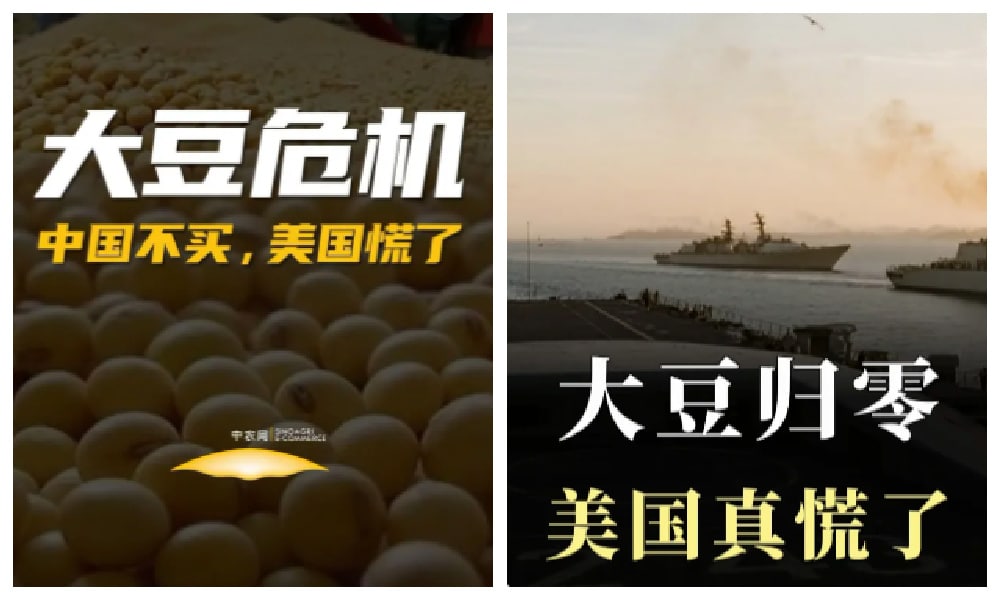
Soybeans have been trending this week. As China is boycotting American soybeans – the fourth most sold agricultural product from the country – farmers in the US are facing uncertain times, as it’s harvesting season and the biggest purchaser of soybean exports is China.
On Tuesday, Trump wrote on Truth Social that China was “deliberately halting U.S. soybean imports,” calling it an “economically hostile act.” He also threatened to terminate business with China regarding cooking oil and other areas of trade as retribution.
On Chinese social media, people seemed unimpressed. The term TACO is also seen more often, a popular abbreviation for “Trump Always Chickens Out.” The Foreign Ministry dismissed Trump’s claims as “unfounded” and emphasized China’s commitment to normal trade relations. On Weibo, commentator Hu Xijin wrote: “Haha, so he [Trump] slaps tariffs on China and blocks chip exports and that’s not considered ‘hostile’? But when China doesn’t buy soybeans, suddenly it is? What kind of logic is that!”
Manya’s Take:
Chinese netizens are treating this latest trade exchange with irony rather than outrage, not only viewing it as a sign of US inconsistency on trade but also there’s some banter about the ‘cooking oil’ threat: when the US side talks about banning imports of “Chinese cooking oil” many assume they meant edible oil (食用油), while what the US actually imports from China is used cooking oil (UCO, 废食用油/地沟油) — waste oil that’s recycled to make biofuels. So the joke is that even Trump himself is seemingly mixing up cooking oil and used cooking oil, moreover threatening a ban that would hurt itself more than China, turning this trade spat into a moment of internet humor.
3. Nanjing Deji Plaza Faces Backlash Over VIP-Only Restrooms
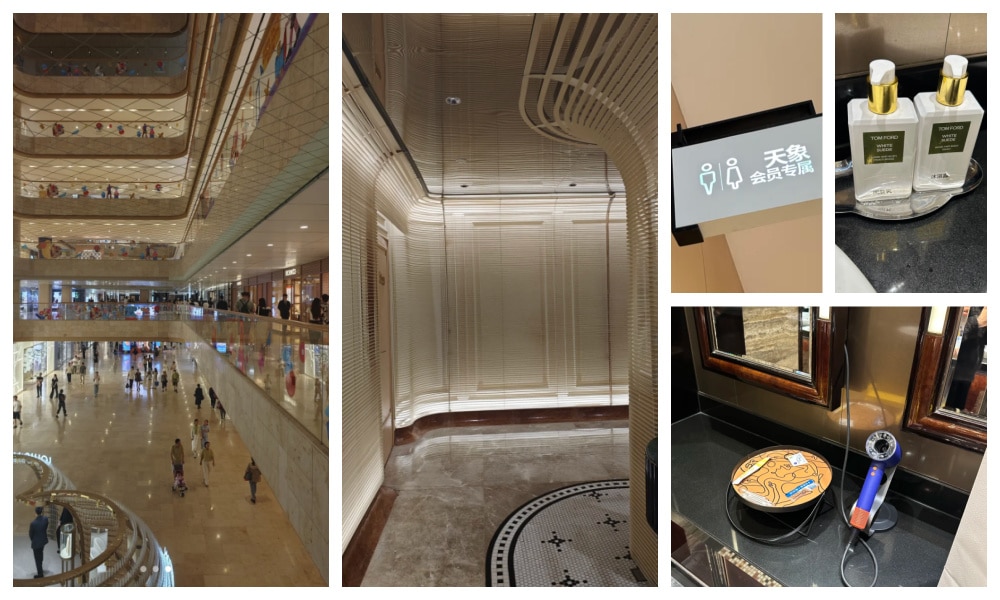
The exclusive members-only restroom at Nanjing’s Deji Plaza.
Nanjing’s luxury shopping mall Deji Plaza (德基广场) has sparked controversy after introducing members-only restrooms accessible exclusively to VIP members (天象会员) who spend over 200,000 yuan ($28,000) annually. Access requires scanning a Deji membership QR code.
Beyond offering peace and privacy, the restrooms feature Tom Ford vanity sets, Jo Malone handwash, and Dyson hairdryers. One Xiaohongshu blogger (and VIP member) noted, “The maintenance cost here is ten times that of a regular restroom.”
After news of the VIP restrooms went viral, it fueled debate about turning ‘a basic human need’ into a ‘class privilege’ or “privatizing a public facility.” One user commented, “Now even restrooms have to reflect the wealth gap?”
Despite the criticism, curiosity grew — many users purchased “code-scanning services” on secondhand platforms to gain access, quickly undermining the restroom’s exclusivity. In response to the controversy, Deji Plaza stated that the members-only restrooms would soon be dismantled and converted into a regular public facility. Regardless, and despite the backlash, the initiative seems to have been fruitful in terms of brand name recognition, as it got everyone talking about Deji Plaza.
Manya’s Take:
There’s some irony in this story: there’s controversy over a mall toilet being “VIP,” yet at the same time, it’s the exclusivity that makes people want to try it. According to the latest posts on Xiaohongshu (XHS) by Deji Mall visitors, the VIP toilets are already gone, and people are back to complaining about the restrooms being too crowded and dirty. One XHS commenter (西蒙吴) had the best take on the issue: in a time when Chinese media are working to downplay the country’s wealth gap and ease public resentment, Deji Mall made the right move by dismantling the card-access VIP toilets — if not for the pressure of online public opinion, authorities might have stepped in themselves. It was an unwise move simply because it was all about a toilet: unlike VIP waiting areas or service counters, consumers don’t like restrooms being divided by class. A smarter approach would have been to create a VIP lounge that just happens to include a restroom.
4. Arc’teryx Responds to Tibet Fireworks Show Environmental Damage Investigation

The controversial fireworks show held in Tibet on September 19.
This is a topic that has sparked outrage and continued discussion in China over the past weeks. On September 19, a major fireworks event was held at an altitude of around 5,500 m or 18,000 feet in Tibet’s Himalayas, created by famous Chinese artist Cai Guoqiang (蔡国强) and sponsored by the outdoor brand Arc’teryx.
The 52-second show, titled “Ascending Dragon” (升龙) was supposed to impress people for its spectacular and colorful use of 1,050 fireworks, but it triggered outrage instead: critics blasted it as tone-deaf commercialization and ecological abuse of sacred and fragile land, and soon an investigation was launched.
Now, the outcome of that investigation has also become a major talking point as it revealed disturbance to local wildlife and caused significant environmental damage of over 30 hectares of grassland.
Cai Guoqiang and his studio will be held legally accountable for environmental damage, and Arc’teryx, as a sponsor of the event, will also bear legal responsibilities. Furthermore, the relevant county officials who had initially approved the show without going through the proper channels are also punished: Party Secretary Chen Hao (陈浩) has been dismissed, and nine other county officials received formal penalties ranging from removal to warnings.
Manya’s Take:
A lot has already been said and written about this controversy. What it comes down to, in the public perception in China, is that the high ambitions and personal goals of the artist and the Arc’teryx brand — which built its image around environmental responsibility and authentic outdoor culture — were pursued at the expense of Tibet’s fragile environment and marginalized communities. Their so-called “dreamlike” event left lasting scars for a fleeting 52-second spectacle. More than just serving as a warning for brands to ensure their actions align with their “eco-friendly” promises, this entire case will undoubtedly go down in history as a moment of awareness — a case study for future art events and large-scale performances in nature in China — on what not to do, and on how to balance spectacle with responsibility.
5. Nobel Laureate Yang Chen-ning Passes Away at 103

Yang Chen-ning passed at the age of 103.
The death of the renowned Chinese theoretical physicist Yang Zhenning (杨振宁, 1922), also known internationally as Chen-Ning Yang, China’s first Nobel laureate in physics, has been trending across Weibo, Douyin, Zhihu, and Toutiao in recent days. Yang passed away in Beijing on October 18, 2025, at the age of 103, just weeks after celebrating his birthday on October 1.
On social media, Yang is remembered as a legendary physicist who devoted his life to science and truth. He shared the 1957 Nobel Prize in Physics with Li Zhengdao (李政道) for discovering parity violation in weak interactions, and co-developed the Yang–Mills theory with Robert Mills in 1954, a cornerstone of modern particle physics.
Many online tributes also recall Yang’s lifelong friendship with nuclear physicist Deng Jiaxian (邓稼先, 1924–1986). The two met in middle school and went on to become giants of Chinese science. Yang’s wife, Weng Fan (翁帆), has also become part of the online remembrances. Over 50 years his junior, she met Yang while she was a student; they married when she was 28 and he was 82. Her tribute to Yang, expressing gratitude for having shared his company for many years, has received over 140 million views on Weibo.

Manya’s Take:
There is certainly a strong sense of national pride in the accomplishments of Yang Chen-Ning, but on social media, much of the attention also centers on his relationship with his wife, who was 54 years younger. Many see Yang’s passing as a moment of reflection — was she there for the money and fame, or for love? Opinions are divided, but the fact remains that the two were married for over twenty years, and she stayed by his side throughout. Some argue that Yang was simply so extraordinary, in both mind and body, that he naturally connected with younger people — and they with him. Others say their love was “timeless,” that true soulmates (灵魂伴侣) do not see age. Either way, it’s clear that 2025 netizens aren’t all cynics — there are quite a few romantics out there.
Spotted a mistake or want to add something? Please let us know in comments below or email us. First-time commenters, please be patient – we will have to manually approve your comment before it appears.
©2025 Whatsonweibo. All rights reserved. Do not reproduce our content without permission – you can contact us at info@whatsonweibo.com.
China Memes & Viral
China’s National Day Holiday Hit: Jingdezhen’s “Chicken Chop Bro”
From viral street food vendors to China’s donkey crisis and new eldercare services, here’s this week’s Weibo highlights in What’s on Weibo’s China Trend Watch.

🔥 What’s Trending in China This Week? Stay updated with China Trend Watch by What’s on Weibo — your quick overview of what’s trending on Weibo and across other Chinese social media, curated by Manya Koetse.
What’s inside:
- 1. Jingdezhen’s “Chicken Chop Bro” Becomes Nationwide Meme
- 2. China’s 2025 Golden Week Travel Trends
- 3. China Faces Donkey Shortage Crisis
- 4. Word of the Week: “Ride-hailing for Relatives” 亲属打车 Qīnshǔ Dǎchē
- 5. What’s Inside at a Glance
1. Jingdezhen’s “Chicken Chop Bro” Becomes Nationwide Meme
From Beijing to Zibo, every now and then, food stall vendors go viral — for their charm, their uniqueness, and most of all, their tasty food. The star of this moment is 48-year-old Li Junyong (李俊永), who runs a small fried chicken stall in Jingdezhen, Jiangxi Province, with tight rules on who he serves, when, and how.
Li has suddenly become one of the most trending people on Chinese social media under the nickname “Chicken Chop Brother” (鸡排哥 jīpáigē).
Li initially gained popularity among customers for his frantic, multitasking energy — he doesn’t mess around when it comes to his chicken chop business, with superspeed and a clear order of serving customers (“I’ll first do you, then finish yours, then I’ll serve you 做完你的做你的”) and rules such as: no individual customers after 4:30 PM; students pay 1 yuan (about $0.15) less than regular passersby (after 12:00 PM, however, it costs 1 yuan more as punishment for being indecisive); and customers must open the plastic bag themselves before he puts the hot chicken cutlet inside.
The serious way he goes about dealing with his chicken chops almost makes you think he was making big business deals instead of selling to middle school students. In the end, it’s that attitude that gained him social media fame, as students started referring to him as “Head of Chicken Cutlet Operations” (free translation for 鸡排主理人 Jīpái gē Zhǔlǐrén).
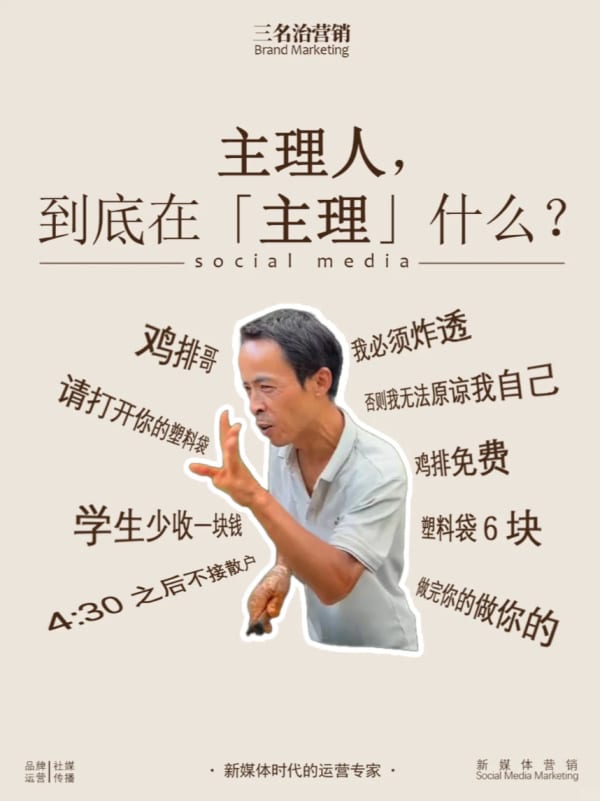
Head of Chicken Chop Operations: “Please open your plastic bag”, “No individual customers after 4:30 PM”, etc.
In light of Li’s explosive popularity, his chicken chop stall now sees extremely long queues, and local authorities and city management have had to intervene in order to control the crowds and keep the location safe.
There are definite downsides to such sudden fame, and Li is not the first street vendor this has happened to.
In 2023, for example, Beijing’s ‘Auntie Goose Legs’ (鹅腿阿姨) went viral, and the food stall owner became so overwhelmed that she temporarily had to take a break from her food stall, emotionally sharing how she said she felt too much pressure because of how the situation was unfolding, and that she just wanted to sell her goose legs in peace (“只想平平安安做烧烤”).

Long lines for Auntie’s goose legs.
It seems that “Brother Chicken Chops”, in line with his reputation as the chicken chop CEO, is trying to turn his viral moment into a sustainable business. According to Sina News, Li has drawn in relatives to help him. He reportedly has taught them how to make and sell his tasty fried chicken chops, and now his Chicken Chop Family (“鸡排家族”) has grown to a total of nine stalls.
Over the past week, Li has also joined several social media platforms, including Xiaohongshu, to build a social following that will last after the hype calms down.
Meanwhile, Li is the meme of the moment. As many Chinese workers experience working stress before the National Day holiday, they’ve used his superspeed working style videos to express the pressure they feel to finish all their deadlines. See videos here.
— What Else Is Trending —
2. China’s 2025 Golden Week Travel Trends
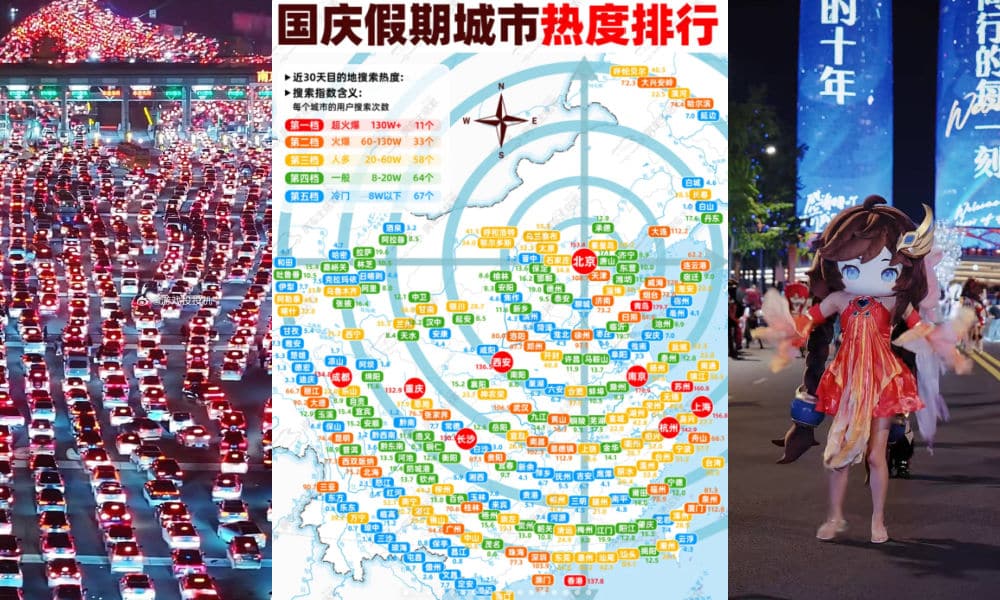
China’s longest holiday of 2025 is coming up, combining National Day (国庆节) and Mid-Autumn Festival (中秋节) into an eight-day Golden Week from October 1–8. If you’re traveling in China this week, good luck — the country’s transportation infrastructure is being pushed to its operational limits.
On September 30, the first “smart people” who opted to leave early to avoid traffic jams already found themselves stuck in them. China’s Ministry of Transport estimates a staggering 2.36 billion trips will be made during this period, with October 1 expected to see over 340 million travelers — surpassing the historical peak of 339 million recorded during Spring Festival earlier this year.
🔸 This week is going to see a lot of events. According to the Ministry of Culture & Tourism, more than 12,000 cultural activities will be held across China during the eight-day holiday period, including over 300 large-scale light shows.
🔸 Chinese local tourism offices are going all in on city marketing and are finding new strategies to make themselves more appealing to young travelers. Chengdu, for example, as Tencent’s gaming hub, is integrating the 10th anniversary of the super popular mobile game Honor of Kings (王者荣耀, Wángzhě Róngyào) into its cultural tourism strategy this year, organizing game-themed city walks, exhibitions, and more.
🔸 China’s travel platform Trip.com reported that interprovincial travel bookings have surged 45% year-on-year, with particularly strong interest in remote destinations like Xinjiang, Tibet, and Inner Mongolia. Searches for hotels in these regions jumped 60% compared to last year. This reflects a shift among middle-class Chinese tourists toward experiential travel and natural landscapes rather than crowded urban attractions.
🔸 The holidays are a time for relaxation, reunions, and eating mooncakes, but it’s also a stressful time for Chinese employers who must comply with labor regulations while managing workforce availability and overtime obligations. Under China’s Labor Law, employees working on statutory public holidays—October 1–3 and October 6 (the official Mid-Autumn Festival date)—must receive at least 300% of their normal daily wage. For adjusted rest days (October 4–5 and October 7–8), employers must provide either 200% overtime pay or compensatory time off. The State Council designated September 28 (Sunday) and October 11 (Saturday) as make-up workdays, but private companies have flexibility to adjust their own schedules.
3. China Faces Unprecedented Donkey Shortage Crisis
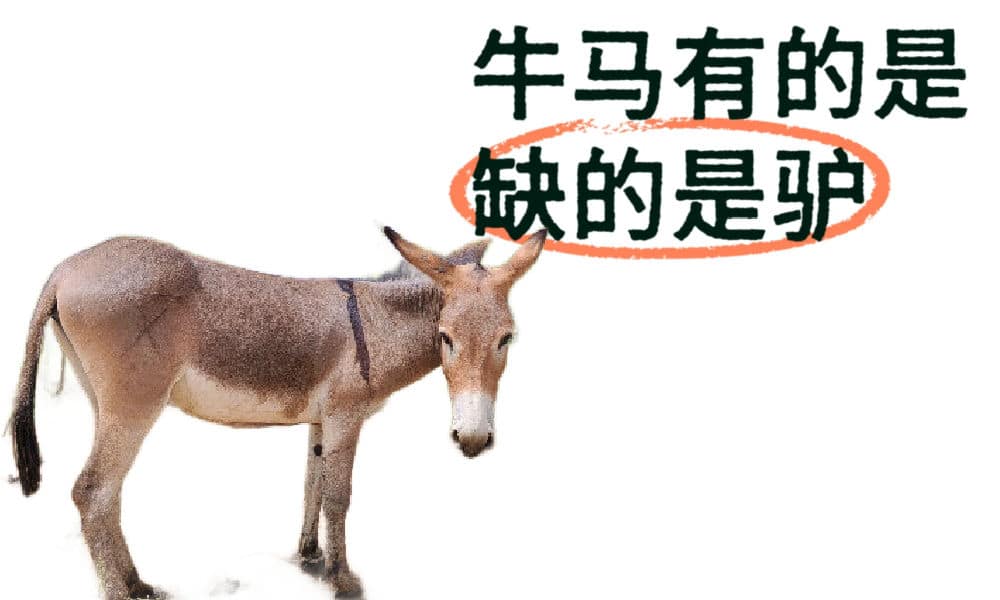
China is facing a serious donkey shortage. China’s donkey population is far below market demand, and the prices of donkey-related products continue to rise. The Donkey Branch of China’s Livestock Association (中国畜牧业协会驴业分会) addressed this issue in Chinese media earlier last week, telling China News Weekly (中国新闻周刊): “We have plenty of cattle and horses in China now — just not enough donkeys” (“目前我国牛马都不缺,就缺驴”).
4. “Ride-hailing for Relatives” 亲属打车 Qīnshǔ Dǎchē

Tencent has rolled out a new function via WeChat Mini Programs on September 26, aimed at helping seniors who struggle with app-based ride-hailing. Thanks to the new function, now live nationwide, users can order rides on behalf of older relatives directly in WeChat.
Adult children who want to help out their less tech-savvy (grand)parents or other senior relatives can now bind their account to their own, remotely pre-set pickup and drop-off locations, as well as payment methods, and track their journey for safety.
What makes this different from the possibility of just ordering a ride for someone else is that the seniors stay in control to some extent and can see their own journeys on their own phones. Children can configure settings on their side, while the interface for the elderly users is simplified. This allows seniors to ride independently, with a little help from their family.
The move is part of a broader effort in China to make it easier for seniors to stay involved in the digitalization of society.
The word to know is 亲属打车 qīnshǔ dǎchē, consisting of “亲属” qīnshǔ (relatives) and ride-hailing 打车 dǎchē.
5. What’s Trending at a Glance
- ✈️ The 27-year-old Sichuan creator “Tang Feiji” (唐飞机) died in a plane crash while livestreaming on Sept 27. The ultralight aircraft, piloted and purchased by Tang himself, went out of control and crashed before catching fire. Over 1,000 viewers were watching live, with the chat flooded by messages pleading for someone to rescue him. Local village officials confirmed his death. The tragedy is fueling debate over amateur aviation and extreme content creation.
- 🟢 Weibo has rolled out a visible “online status” feature on personal pages, showing when users are online, and not everyone is happy with it. The new feature is met with criticism from concerned users who don’t want others to see they’re online. It brings back memories of China’s legendary IM app QQ, which, like MSN, showed the online status of users.
- 🥿 A Chinese Marriott hotel location in Changzhou has come under scrutiny adn triggered hygiene concerns after guests found out that the in-room hotel slippers were being reused. The hotel has admitted to disinfected the disposable slippers and reusing them 2–3 times, without disclosing this to guests in advance.
- ⚖️ China’s cyberspace authorities issued stern warnings and announced penalties on various Chinese social platforms recently, including Xiaohongshu, Weibo, and Kuaishou, which are blamed for not keeping celebrity gossip and low-quality content in check and for influencing their hot search rankings. This is all about algorithm governance and the tightrope platforms walk in serving readers, attracting attention, and satisfying regulators.
- 👵 “Outsourced Children” services for Chinese seniors went trending recently. In Dalian, an initiative offering companionship and mediation services for seniors charges 500–2,500 yuan ($70–$350) per visit and has apparently been quite a success, underscoring strong market demand of eldercare-related services and new opportunities for Chinese students.
By Manya Koetse
(follow on X, LinkedIn, or Instagram)
Spotted a mistake or want to add something? Please let us know in comments below or email us. First-time commenters, please be patient – we will have to manually approve your comment before it appears.
©2025 Whatsonweibo. All rights reserved. Do not reproduce our content without permission – you can contact us at info@whatsonweibo.com.
Eye on Digital China is a reader-supported publication by
Manya Koetse (@manyapan) and powered by What’s on Weibo.
It offers independent analysis of China’s online culture, media, and social trends.
To receive the newsletter and support this work, consider
becoming a paid subscriber.


China Trend Watch: Hong Kong Fire Updates, Nantong’s Viral Moment & Japanese Concert Cancellations

Signals: Hasan Piker’s China Trip & the Unexpected Journey of a Chinese School Uniform to Angola

About Eye on Digital China — Powered by What’s on Weibo

China Trend Watch: Japan Tensions, Nexperia Fallout, Yunnan’s ‘Wild Child,’ & “Modern Opium”

Eye on Digital China: How Chinese Social Media Evolved from the Blog Era to the AI-driven Age

The Wong Kar-wai Scandal Explained: The Dark Side of ‘Blossoms Shanghai’

From Schadenfreude to Sympathy: Chinese Online Reactions to Charlie Kirk Shooting

From Nobel Farewell to ‘VIP Toilets’: What’s Trending in China

From Tents to ‘Tangping Travel”: New Travel Trends among Young Chinese

China’s “Post Parade Afterglow”: 6 Social Media Trends
-

 China Memes & Viral5 months ago
Hidden Cameras and Taboo Topics: The Many Layers of the “Nanjing Sister Hong” Scandal
-

 China Memes & Viral11 months ago
Our Picks: Top 10 Chinese Buzzwords and Phrases of 2024 Explained
-

 China Insight7 months ago
Understanding the Dr. Xiao Medical Scandal
-

 China Digital11 months ago
“Dear Li Hua”: The TikTok/Xiaohongshu Honeymoon Explained